
Tackling deprivation with Christians Against Poverty
By Martin Cowles, Head of Insight at Christians Against Poverty, and Nicole Holgate, Communications Manager at DataKind UK
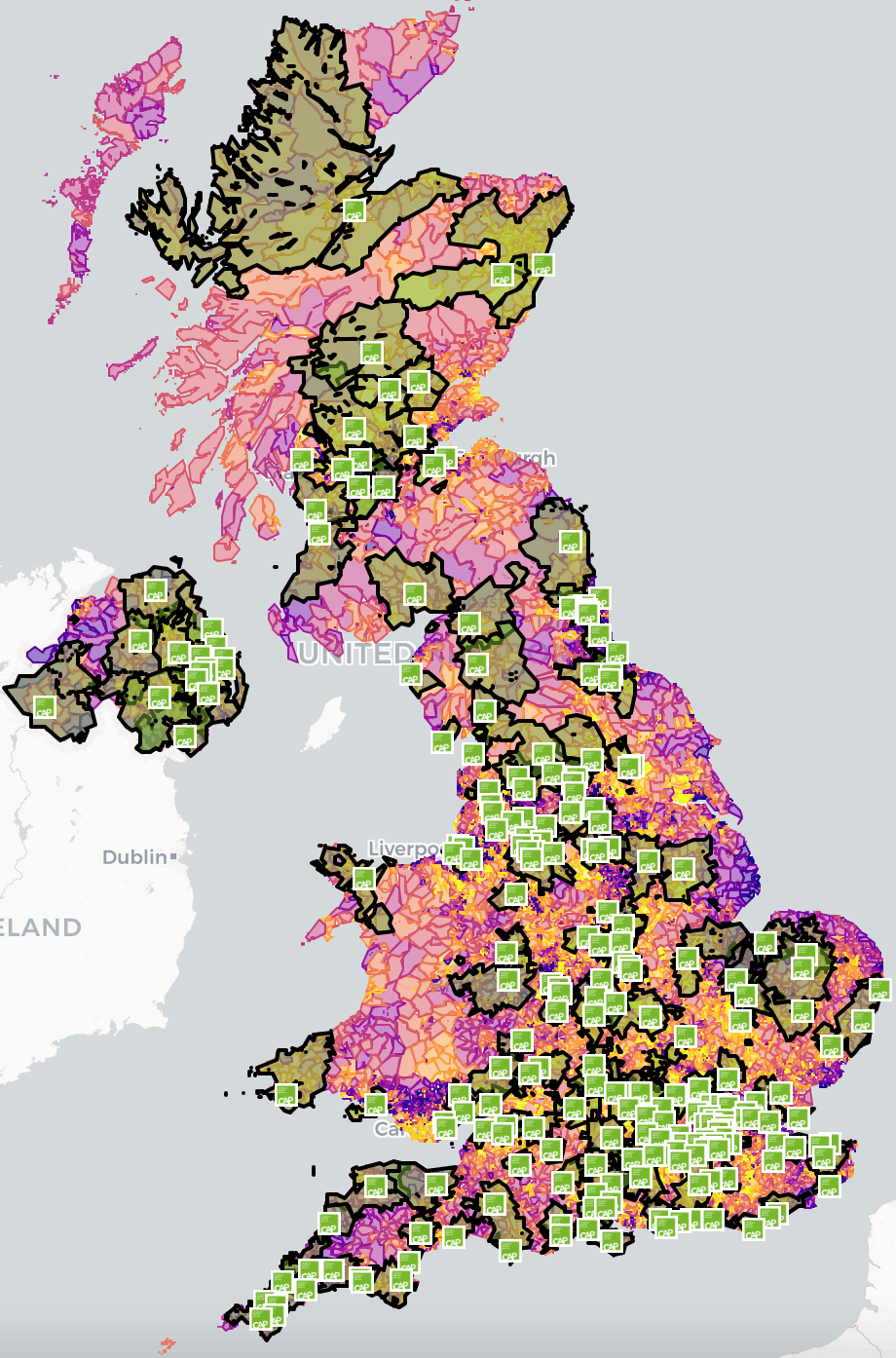
A map visualisation of CAP’s services across the UK
“We’re a face-to-face service, and can only be in certain places, so understanding how it impacted who we saw was the biggest problem we had to deal with.”
Meet Christians Against Poverty
Christians Against Poverty (CAP) provides free debt support across the country, and has an organisational vision of a UK free from poverty. CAP’s main programme is their face-to-face debt counselling, which is delivered in partnership with a network of local churches. Through this programme, they provide holistic support to 5,000 new people each year.
Sorting out your finances is a necessary chore for many people. But typical online forms may not be helpful if you are facing a binbag full of paperwork. People facing challenges alongside their debt, such as different access needs, low family income, or isolation, can quickly get left behind. CAP is there with higher levels of support to help people overcome these barriers and become debt-free.
CAP’s data journey
CAP has been on an incredible journey. When current Head of Impact, Martin Cowles, first began working on analysis there, data roles were not as well recognised, and data people in the organisation tended to wear a lot of different hats. “We wanted to bring credibility to what we were doing,” he says. “The last time we worked with DataKind UK, in the pandemic, really helped with that.”
Martin and his colleagues first collaborated with us, entirely remotely, in early 2020. They examined how their advisors collected data when they first onboarded potential clients, in order to recommend the best route out of debt for them. You can learn more about that project in our blog, Getting people out of debt with Christians Against Poverty.
This work helped cement CAP’s ‘Data Nerds Club’, where staff members working on data in different departments could come together as peers to compare notes, geek out about analysis approaches, and support one another. But as the organisation grew to be more ‘data-minded’ as a whole, the Club was retired.
CAP now has data teams of at least a couple of people within its fundraising and operations, as well as Martin’s team, impact and evaluation. They work to gain a strategic understanding of CAP’s target service users, the surrounding climate that affects their work, and the kind of impact they need to see, in order to evidence why they provide support the way that they do.
They also look more closely at monitoring and evaluation for each type of service they provide, and finally, run ongoing evaluation of new ‘products’ - trialling and developing ways of working that may help more people. “We’re lucky enough to sit in this middle space that really connects the business to the strategy,” he comments.
Sharing carefully
Preparing for a project is as important as tackling and answering strategic questions. CAP’s decision to work with DataKind UK again after five years meant that a lot had changed for them internally, and they had to figure out the practical processes of sharing their data in a way that was safe and secure. They also wanted to compare their data to another open source, which had to be extracted.
For Martin, the data sharing process was one of the trickier things to tackle before they could run any exploratory analysis. “It was one of the areas where I felt most uncertain - how are we going to ensure this is safe, do we need a Data Protection Impact Assessment?” It’s a crucial part of DataKind UK’s responsible approach, ensuring safeguarding, privacy, and security throughout a project.
Coaching and curiosity
Once the data was safely shared, Martin stressed how useful it was to be guided through the scoping process and never stop examining what they could learn from their data. “We needed to go on this mental journey. It forced us to ask more questions,” adds Martin. “That level of curiosity was present throughout the whole thing… I really felt the value of the data analysts not just doing what we asked.”
CAP embraced having their assumptions and requests challenged by volunteers in order to tease out what the most useful analyses and outcomes could be. The project shifted from creating static user personas and clustering client types, to the realisation that they needed to understand the geographical location of their service users, and what that meant in the context of an overall picture of deprivation in the UK.
Ensuring the most impactful support
CAP partners with churches to provide their outreach, and wanted to know more about how this affects who they reach and support. “We’re a face-to-face service, and can only be in certain places, so understanding how it impacted who we saw was the biggest problem we had to deal with.”
CAP explored if distance was a factor, as sometimes people were helped by churches that were perhaps from a different community. They also explored if deprivation made a difference to the complexity of someone’s situation. But the issues faced by people in debt were similar across every area, and there was very little difference in final outcomes, regardless of where they were from.
If this main client group has similar experiences of debt no matter what kind of area they are in, CAP can make an active choice to support more deprived communities where they know the highest levels of impact can happen.
It presents a golden opportunity for their regional directors to refresh their development plans and build their networks, knowing that they will be able to focus on helping people and communities who need it most.
Martin left us with glowing praise, “From start to finish, from problem framing to final presentation - we learnt something important on every step of the journey. It also sparked a ton of curiosity and momentum into how we could continue to make evidence-based decisions in the future.”
"Working with DataKind was an experience which not only supercharged our existing efforts, but also helped us grow as a data team. It is a real highlight of the work I have been involved in this year.”
