Datasets, culture, and governance: what we learned at our unconference
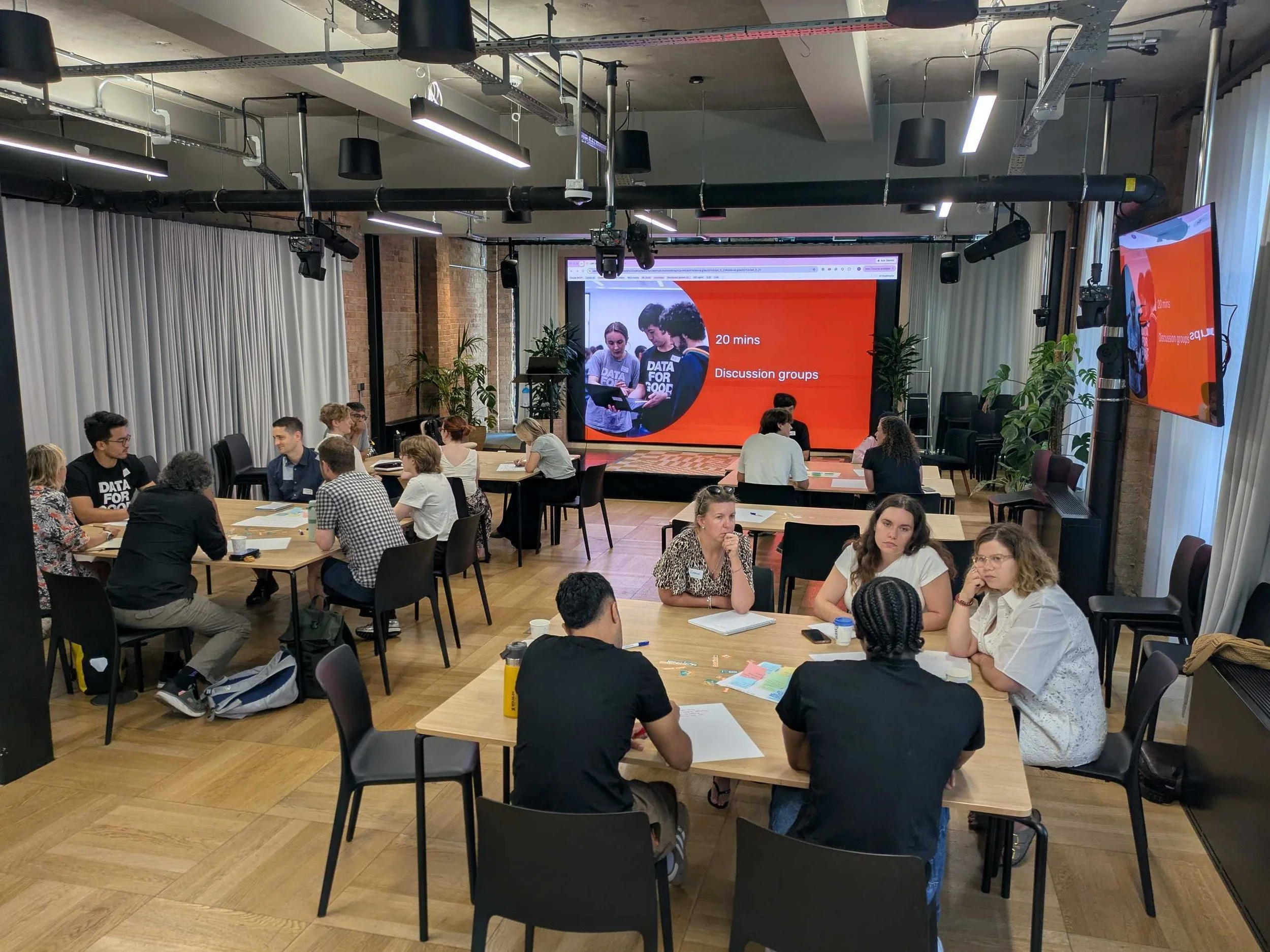
London Data Week wrapped up in August, and we had a fantastic time at our ‘mini unconference’ discussing the data challenges being faced by the third sector. So we want to reflect on what we learned, as well as give a huge shout out to the volunteers who gave their time, and the hardcore data fans who came out in the hot weather!
Getting the right data
One discussion group focused on data sets, especially geospatial and place-based data and the uses of maps for comparison, understanding needs, and measuring impact. Place-based data plays a huge role for many organisations, whether you’re trying to work with councils to find people in need, share useful data to tackle common challenges, or strategically curate relevant information from multiple different data sets. There are also ethical considerations, such as creating granular enough mapping without disclosing identifiable data, and the need for place-based data to be accurately informed by people on the ground, not extractive.
If these are challenges you’re facing, there are lots of mapping tools and approaches, from no-code plug and play options, to diving into learning geospatial techniques, and everything in between. Suitable visualisation tools mentioned on the day were DataWrapper, Tableau, PowerBI, and QGIS. Most of these are explored more in our Putting your charity on the map resource, and James Bowles’ blog Mapping tools for charities. Another interesting example was the Friends of the Earth open data portal and Local action group community campaigns.
More broadly, there were discussions about how to find useful external data sets. At DataKind UK, we do a lot of work on how to ask questions of data and how to understand whether you collect the right data.


Culture vs everything else
A lot of discussion centred around the clash between buy-in and resources, timing, and culture. This felt like a broad category, but the important common factor was people. There was a feeling of a lack of statistical expertise in house that made it difficult to make data useful, make sense of results, and use data in decision making.
Challenges included how to get other colleagues asking useful questions of data, and getting volunteers in more transient roles up to speed. Several attendees wanted their leadership to more actively adopt data and tech and improve their understanding of the insights in the face of a general understanding of data as ‘magical’ or ‘mysterious’. It felt important for everyone in an organisation to feel ownership of their data, and to feel confidence in using it for decision-making or to evidence impact. Crucially, there was agreement that culture should change from leadership downward, so managerial or C-suite buy-in is key.
Training everyone on the ‘why’ of data will go a long way towards getting them into the ‘what’ and ‘how’. If your team doesn’t have much capacity to learn data skills, they can still feel like they have a stake in your data by understanding why it’s important and useful to your mission as a whole. Encourage a culture of always asking questions, and never making assumptions, of the data.
Clear examples of what data can do for your organisation will help to engage colleagues who don’t ‘get it’, and motivate them to understand the part they play as responsible data stewards in this larger picture. Those asking about visualisation and storytelling with data will also find a treasure trove of resources online. Just make sure that examples are actionable, and don’t unnecessarily inflate people’s expectations!
Other suggestions to boost data literacy were to get back to basics where possible, and remember that not everything needs a highly technical solution. Shifting culture takes time, effort, and working both from the top down and the bottom up.
Tools and how to use them
A very interesting question was how to decide when to implement data tools, and how to know what tools to use for what purpose. Don’t feel pressure to adopt cutting-edge technology unnecessarily! What works for an organisation of your size may be spreadsheets, and high tech solutions will not solve foundational problems.
Infrastructure is a commonly under-resourced part of a third sector organisation. Clarity of purpose and due diligence is essential, especially when funding is hard to secure. A key factor was finding tools that are sustainable, both financially (free being the ideal) and in terms of upkeep and skills training for the team. Taking a look at your data maturity (such as by using Data Orchard’s Data maturity framework for the not-for-profit sector) may help to uncover whether the issue lies in your systems, or elsewhere in your organisation. If you decide that financing a tool is the only way forward, here is a crib sheet about getting funding for data and digital work.
This especially applies to AI. Anyone interested in implementing AI tools should have a look through our webinars and resources, created in partnership with Insight Infrastructure at the Joseph Rowntree Foundation. If you’re keen to research different kinds of implementation, or work with your colleagues to create a policy and prevent everyone doing their own thing with AI, then our ethical and policy webinars will be particularly useful.


Governance at the foundation
Governance was a factor that came up across teams, tools, and data in every discussion. Data governance, such as retention, security, and standardising data collection, is a vital foundation of being able to produce useful analysis. It can be the missing piece of how to improve data culture so that organisations can get the best insights possible using what tools they have.
There was a strong awareness of the precarious balance between keeping up with tech innovation and experimenting with data, versus the many risks, particularly surrounding AI. Preparation is crucial: it is better to have it and not need it, as they say. Your business case is that it is low-cost and essential for your team to have GDPR, security, or data protection training. Not having it could result in a Charity Commission fine, or in a worst-case scenario, data being held to ransom.
Luckily, there are many free and low-cost options to guide you through the basics of data governance. A great starting point is the ICO, who have a lot of tools and guide policies. There is a huge array of free data and digital support, including cyber security training and essentials from organisations such as the National Cyber Security Center.
To wrap up, the room at London Data Week was full of connections being made and ideas being sparked. Our mission is not only to get this sector using data well, but to rave about it, so take a look at the many fantastic cases of great data use we have in our blog. We’ll also keep building on these resources and ideas, so keep following us!