
Pilots, projects and plans
By Nicole Holgate, Communications and Community Manager, DataKind UK
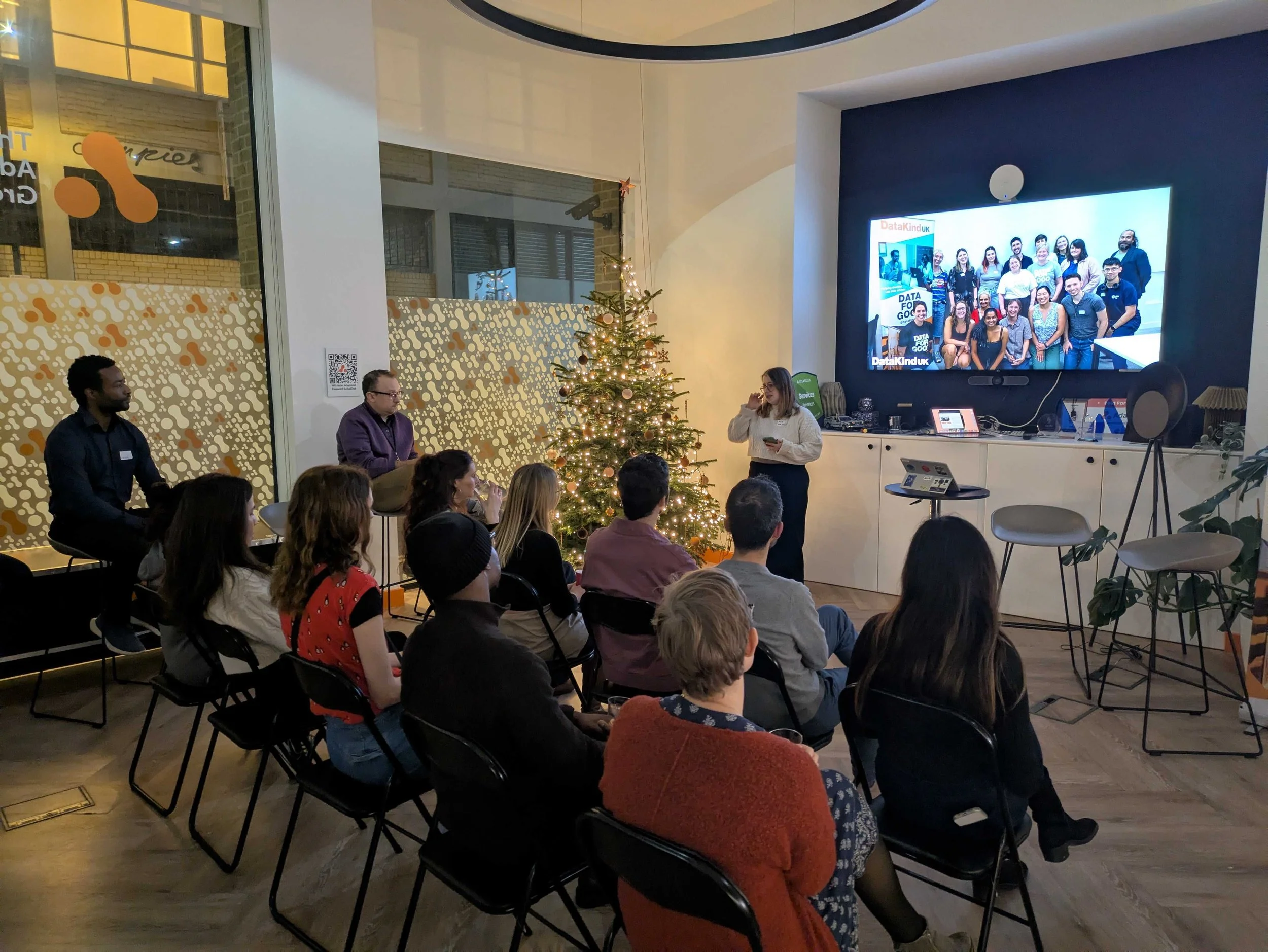
Looking back at the year during our community winter party
To pilot the first project of what we hope will become a regular series, we worked with our community to run a deep dive into our volunteering processes.
Better data, better impact
The work we do at DataKind UK is only possible because of an amazing community of experts who provide data support to our third sector partners. The most impactful ‘magic’ happens when we can build and support an engaged volunteer community with a variety of experience and the right skills for different third sector partner needs. This gets the best out of both the volunteers and the organisations they support!
Over the past year, we updated our volunteer application process to improve what information was collected about the skill sets and backgrounds of our community. And we had an amazing response. From launching our volunteering form in mid-June 2025, to closing it in early September 2025, we received more than 400 applications, of which almost 300 went on to fully complete our onboarding process and join our pool of data volunteers.
This meant we had a lot of data about our new volunteer community, but limited capacity to analyse it ourselves.
Piloting the project
As the pilot ‘Building’ project of what we hope will become a regular series, we decided to use the recently collected volunteer recruitment information to run a deep dive into DataKind UK’s community and processes.
The project had two major goals:
1. Look at and learn from our internal data.
We wanted teams of volunteers to help us analyse the data and find key information about how well our application process is working, such as conversion rate, or time taken from application to completed onboarding. And we wanted to learn more about our new volunteer community, such as what the distribution of skills is, and where volunteers are based.
2. Pilot a way to involve multiple volunteers or teams of volunteers in a scalable, remote project that could generate wider solutions.
Even more broadly, we wanted to create an approach for building more tools, products, and in-depth analyses that support responsible data use and generate sector-wide solutions, using the contributions of our community.
Planning the format
Our sister organisation DataKind had already demonstrated ways to approach this in their DataKit events, which act as international, remote hackathons for social issues. Based on their and our experience of previous projects, we created a project structure and timeline where small groups would be introduced to the data and each other, and over roughly one month, each tackle an analysis question.
Our Data Science and Impact Lead Caitlin led the preparation of a clean, anonymised data set, finalising what we wanted to know, and scoping some specific questions suitable for a short exploratory project. No mean feat!
We wanted the analysis to help us understand a few different things:
How well is the application process working?
What skills do our volunteers have?
What are our volunteers’ backgrounds: where are they based, what jobs do they have?
What are their preferences: when do people want to volunteer, and for what type of role?
Running the project
With the timeline and scoping ready, we sent a call out to the community for people with a mixture of data analysis, data visualisation, and mapping skills, and chose final participants at random to be put into groups. Each group would then work on the data set to answer a specific question. We are lucky enough to have an existing core of long-term volunteers who could also support these teams and review the final outputs of the project.
The teams met and worked remotely, with access to the staff team and other experienced community members to guide them. Crucially, we planned several touch-points during the project for the volunteers to get to know the data, form their teams, and finally, present back a summary of what each group had found.
Despite being introduced into brand-new teams and handed data they had never seen before, everyone worked brilliantly together to create a variety of outputs. By the date of the summary presentations, they all had plenty of findings to show. We’ll share some of the insights, recommendations, and more of our plans for next year, soon.
A massive thanks to everyone, long-term community members and brand new volunteers, who took part!
